FACTS:
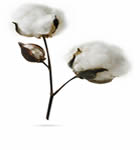
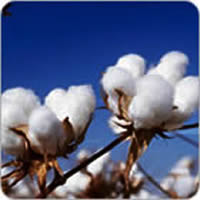
Cotton is a shrubby plant that is a member of the Mallow family, other members of the mallow family include hollyhocks and hibiscus, used to brighten gardens all over the world. The name refers to the cream-colored fluffy fibers surrounding small cottonseeds called a boll. The small, sticky seeds must be separated from the wool in order to process the cotton for spinning and weaving. The seeded cotton is cleaned, carded (fibers aligned), spun, and woven into a fabric that is also referred to as cotton. Cotton is easily spun into yarn as the cotton fibers flatten, twist, and naturally interlock for spinning. Cotton fabric alone accounts for fully half of the fiber worn in the world. The cotton plant is a source for many important products other than fabric. Among the most important is cottonseed, which is pressed for cottonseed oil that is used in commercial products such as salad oils and snack foods, cosmetics, soap, candles, detergents, and paint. The hulls and meal are used for animal feed. Cotton is also a source for cellulose, fertilizer, fuel, automobile tire cord, pressed paper, and cardboard.
The greatest diversity of wild cotton species is found in Mexico, followed by Australia and Africa. The discovery of cotton dates back to around 5800 BC in a cave near Tehuacán, Mexico. although it is difficult to know for certain due to fiber decay, Other sources date the discovery to approximately 5000 to 3000 BC.
Cotton was first cultivated about 7,000 years ago by the inhabitants of the Indus Valley Civilization, which covered a huge swath of the northwestern part of the South Asia, comprising today parts of eastern Pakistan and northwestern India, the largest producers of cotton today are China and India but the textile company in these two countries consume up to 90% of what they produce. Every year over 55 million tons of cotton are cultivated and processed throughout the world hence the nickname “white gold”. The demand for cotton in the world market is greater than the supply, making textile companies resort to the use of polyester
Successful cultivation of cotton requires a long frost free period, plenty of sunshine, and a moderate rainfall. The Cottonseed is mechanically planted by machines that plant up to 12 rows at a time. The planter opens a small furrow in each row, drops in seed, covers them, and then packs more dirt on top. Seed may be deposited in either small clumps (referred to as hill-dropped) or singularly (called drilled). The seed is placed 0.75 to 1.25 in (1.9 to 3.2 cm) deep, depending on the climate. The seed must be placed more shallowly in dusty, cool areas and more deeply in warmer areas. With good soil moisture and warm temperature at planting, seedlings usually emerge five to seven days after planting, with a full stand of cotton appearing after about 11 days, disease or soil crust may delay the seedlings appearance and thats why the crust must be carefully broken by machines or irrigation to permit the plants to emerge.
Approximately six weeks after seedlings appear, "squares," or flower buds, begin to form, the buds mature for three weeks and then blossom into creamy yellow flowers, which turn pink, then red, and then fall off just three days after blossoming. After the flower falls away, a tiny ovary is left on the cotton plant, this ovary ripens and enlarges into a green pod called a cotton boll. The boll matures in a period that ranges from 55 to 80 days. During this time, the football-shaped boll grows and moist fibers push the newly formed seeds outward. As the boll ripens, it remains green. Fibers continue to expand under the warm sun, with each fiber growing to its full length of about 2.5 in (6.4 cm) during three weeks. For nearly six weeks, the fibers get thicker and layers of cellulose build up the cell walls. Ten weeks after flowers first appeared, fibers split the boll apart, and cream-colored cotton pushes forth. The moist fibers dry in the sun and the fibers collapse and twist together, looking like ribbon. Each boll contains three to five "cells," each having about seven seeds embedded in the fiber.
Production of cotton have been mechanized in recent times and the cotton plant must be defoliated if it is to be machine harvested, defoliation involves removing the cotton leaves and its often done by spraying the plant with a chemical, the leaves are considered as excess moisture and trash and must be removed. Without defoliation, the cotton must be picked by hand, with laborers clearing out the leaves as they work.
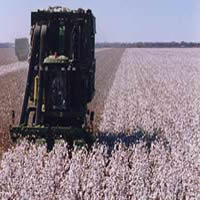
Harvesting is mostly done by machine with two notable mechanical systems, the picker and the stripper. The picker system uses wind and guides to pull the cotton from the plant, often leaving behind the leaves and the rest of the plant while the stripper system chops the plant and uses air to separate the trash from the cotton. Cotton is mostly harvested using the picker system but it must be done after the dew dries in the morning and must conclude before the dew begins to form gain at the end of the day. Moisture detectors are used to ensure that the moisture content is not higher than 12%, or the cotton may not be harvested and stored. Not all cotton reaches maturity at the same time so harvesting may occur in waves, with a second and third picking
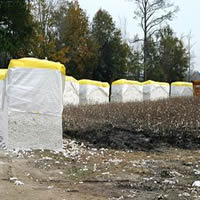
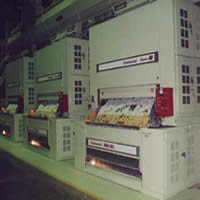
Cotton are mostly stored in modules until it is ready to be ginned,"modules" are water resistant containers. The cotton module builder is a machine used in cleaning and compressing the cotton in water resistance sack usually shaped like giant loaf of bread and can weigh up to 25,000 pounds, it allows the cotton to be stored without loosing its quality prior to ginning. The modules are later loaded into trucks and transported to a cotton gin for processing. A cotton gin is a machine that quickly and easily separates the cotton fibers from the seeds, a job formerly performed by hand. The fibers are processed into cotton goods, and the seeds may be used to grow more cotton, to produce cottonseed oil, or, if they are badly damaged, are disposed.
Before the invention of the gin, it took a farm labourer one day to seperate the fibre and seeds from one pound of picked cotton. The value of cotton are classed according to fiber length (staple), strength, micronaire, color and cleanness.
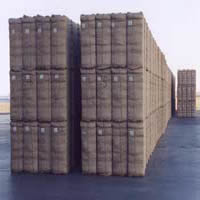
After cleaning and gining, the cotton is conveyed to a press for compressing and baling. Cotton are packed in bales and each bale is tagged and matched to the original module. Compressed and steel strapped bales measure 600 x 900 x 800mm and weigh 270kg. Up to 35 modules can be ginned (processed) per 24 hour shift.
Cotton growing is a long process and farmers must understand the requirements of the plant and keep vigilant look-out for potential problems, pests must be managed in order to yield high quality crops; however, farmers must use chemicals very carefully in order to prevent damage to the environment and must also carefully monitor moisture levels at harvesting so bales will not be ruined by excess water during storage. Soil tests are also imperative, since too much nitrogen in the soil may attract certain pests to the cotton.
The cotton industry relies heavily on chemicals, such as herbicides, fertilizers and insecticides, although a very small number of farmers are moving toward an organic model of production, and organic cotton products are now available for purchase at limited locations, mostly in the West Africa sub-region. Organic farming utilizes biological control to rid cotton of pests and alters planting patterns in specific ways to reduce Pesticide use. While this method of cultivation is possible, an organically grown crop generally yields less usable cotton. This means an organic farmer must purchase, plant, and harvest more acreage to yield enough processed cotton to make the crop lucrative, or reduce costs in other ways to turn in profit.
One of the most economically destructive pests in cotton production has been the boll weevil, other significant global pests of cotton include the pink bollworm, the chili thrips, the cotton seed bug, the tarnish plant bug, and the fall army worm.
Cotton is used to make a number of textile products. These include terrycloth for highly absorbent bath towels and robes; denim for blue jeans; chambray, popularly used in the manufacture of blue work shirts (from which we get the term "blue-collar"); and corduroy, seersucker, and cotton twill. Socks, underwear, and most T-shirts are made from cotton. Bed sheets are often made from cotton. Cotton also is used to make yarn used in crochet and knitting. Fabric can also be made from recycled or recovered cotton that otherwise would be thrown away during the spinning, weaving, or cutting process. While many fabrics are made completely of cotton, some materials blend cotton with other fibers, including rayon and synthetic fibers such as polyester. It can either be used in knitted or woven fabrics, as it can be blended with elastine to make a stretchier thread for knitted fabrics, and apparel such as stretch jeans. In addition to the textile industry, cotton is used in fishnets, coffee filters, tents, gunpowder, cotton paper, and in bookbinding |